
Every seller obsesses over what they are selling. Almost none think about which door they walk through to sell it — and in our universe, the door is a pricing variable as large as anything on the income statement.
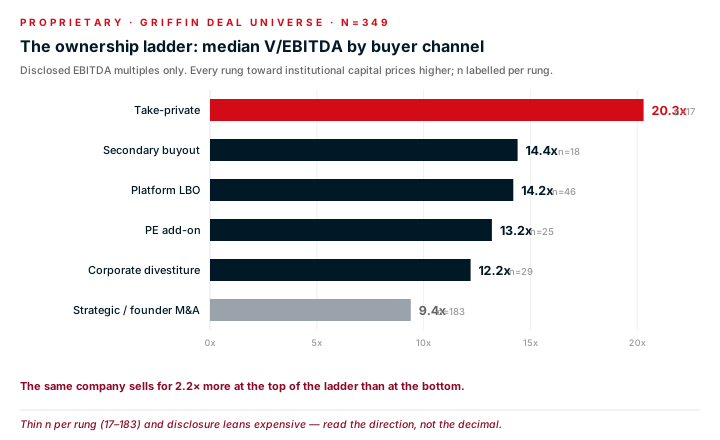
Sort 1,544 transactions by the kind of buyer that closed them and a clean ladder appears. At the bottom rung, a founder selling to a strategic acquirer clears a median 9.4x EBITDA on disclosed deals. At the top, a public company taken private clears 20.3x. In between, the rungs climb in order: corporate divestitures at 12.2x, private-equity add-ons at 13.2x, platform buyouts at 14.2x, secondary buyouts at 14.4x. Each step toward institutional capital prices higher than the last.
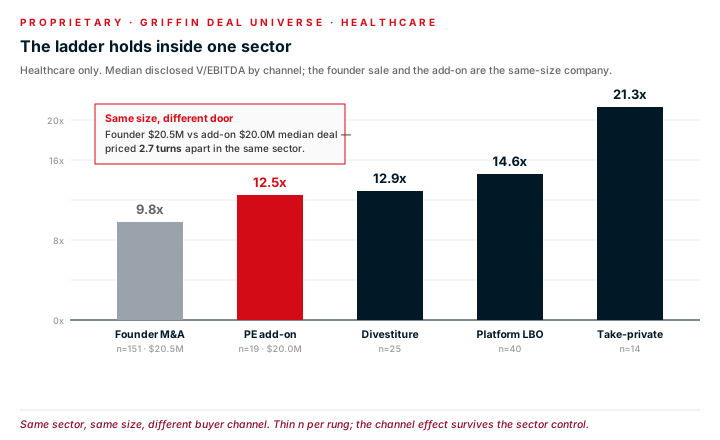
The obvious objection is sector mix — perhaps the richer rungs are simply richer industries. They are not. Hold the sector fixed at healthcare and the ladder survives intact: founder M&A at 9.8x, add-ons at 12.5x, divestitures at 12.9x, platform buyouts at 14.6x, take-privates at 21.3x. Same sector, same ordering.
The sharpest cut sits inside that healthcare panel. A healthcare add-on and a healthcare founder sale are, at the median, the same-size company — $20.0M and $20.5M of deal value respectively. They differ by less than a rounding error in size and by nearly three full turns of EBITDA in price. The one material difference between them is who sat across the table.
Three caveats keep this straight. First, disclosure. The rungs do not disclose their multiples at equal rates, and disclosure leans expensive — the visible deals are disproportionately the larger, more competitively run ones, a bias we have quantified separately: only a minority of private transactions ever publish an EBITDA multiple, and the ones that do trade richer than the ones that do not. Second, the counts are thin — between 17 and 183 disclosed multiples per rung — so these are medians on small samples, not a continuous index. Third, the channels bundle who pays with what trades: a platform buyout is almost always an auctioned, prepared asset, so part of the premium is the preparation, not the buyer.
The ladder is therefore partly a story about which companies enter each channel, not purely about who pays. But the same-size healthcare cut is hard to explain away. When the add-on and the founder sale are the same sector and the same size and still price three turns apart, the channel is doing work that quality and mix alone do not account for.
The cheapest door is the one most sellers use by default: the unsolicited call from a strategic acquirer, answered directly. The richer doors — the run process, the sponsor auction, the prepared carve-out — demand institutional preparation the seller has to supply before the first conversation. The channel is not fixed; it is chosen, and it is chosen early. Where the old roll-up arithmetic still works — cheap entry multiples that compound into an arbitrage — it works in the deals nobody sees, the quiet tuck-ins that never disclose. A seller's job is to make sure they are not one of them.