
The most expensive belief a seller can hold is that the business has a number. It does not. A single company carries four legitimate values at once, each answering a different question and each negotiated against a different counterparty. A seller who walks into a process holding only one of them either leaves money on the table or chases a figure no buyer will ever justify — and which of those two failures occurs depends entirely on which number they picked.
None of the four is wrong. They are not competing estimates of one true value; they are four different questions about the same asset. Confusing them is the most common and the most costly error in a private sale, and it is made most often by sellers who have been told, by someone with an incentive to simplify, that their company 'is worth' a single multiple of a single number.
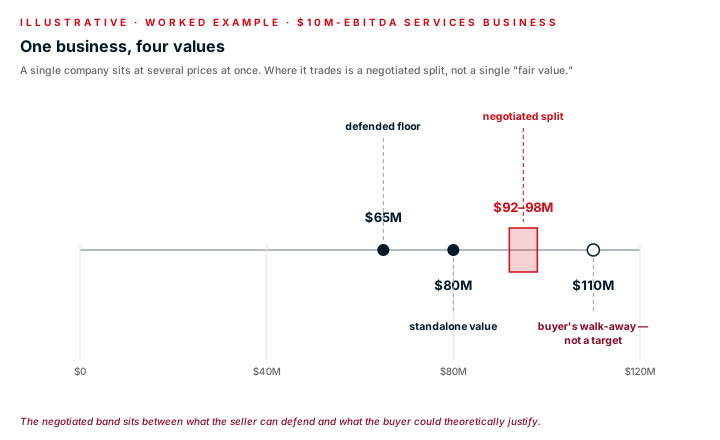
The floor is the defended minimum — the number below which you do not transact. It rests on evidence a skeptical buyer cannot wave away: hard-asset value, an independent appraisal, or a deliberately conservative discounted-cash-flow. The floor is not a target and not an expectation; it is a walk-away, and its only job is to be unarguable.
The standalone value is what the business is worth to its current owner on its own cash flows — an enterprise DCF, the honest center of gravity. It assumes no acquirer, no synergies, and no control premium: the company continuing as it is, discounted at its own cost of capital. It is the value the seller already owns, and the reference point against which every buyer's offer should be measured.
The buyer-specific value is the standalone value plus the net synergies a named buyer can realize — and it is different for every buyer. This is why 'the market multiple' is a category error: there is no single price, because the value of the company changes with who is holding it. A buyer who can lift the target's return on invested capital, or grow it at a return above its cost of capital, is worth more to the seller than one who cannot, and the difference can be estimated rather than felt.
The outer bound is the most a best-fit buyer could pay before the deal destroys value for them: standalone plus all of the net synergies, with none retained. A buyer who pays it keeps nothing — the entire value of the acquisition transfers to the seller. Most will not, and the few who do are the winner's-curse cases the empirical record is full of. The outer bound is a ceiling to understand, not a price to demand.
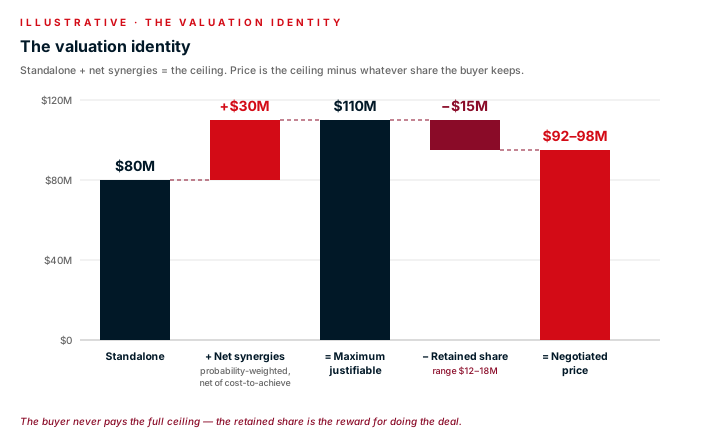
Once the four numbers are on the table, the negotiation resolves into a single identity: price equals the standalone value plus the seller's captured share of the net synergies. The multiple is a result of that arithmetic, not an input to it. The real contest is never over what multiple is 'fair' — it is over how the synergy value between the two sides gets split.
A worked illustration makes the split concrete. Take a services business with $10M of adjusted EBITDA. Its defended floor is $65M; its standalone DCF is $80M; the best-fit strategic buyer's net synergies — valued as probability-weighted cash flows, after the cash cost to achieve them, not capitalized at a run-rate multiple — carry a present value of about $30M. That puts the outer bound at $110M. A disciplined process captures neither all of that $30M nor none of it; it captures somewhere between 40% and 60%, which sets a buyer-specific target of roughly $92M to $98M. Same company. Every one of the four numbers is correct, and each one belongs to a different conversation.
Carry all four into the process at once. Defend the floor with evidence, so it cannot be negotiated down. Hold the standalone value as the number you already own. Open the conversation from the buyer-specific value rather than the standalone — because a buyer who anchors you to 'what the market pays' is quietly proposing to buy your company and keep every dollar of the synergies. And treat the outer bound as a discipline on both sides: the price above which even the perfect buyer should walk. Where the standalone value is itself a sum of separable parts, the same logic applies one level down; and estimating which buyer carries which synergy is the specific work of a buyer-by-buyer assessment. The seller who holds one number negotiates in the dark. The seller who holds four knows exactly which one the buyer is arguing about.