
When a corporation sells a division, the folklore says buyers should smell distress — stranded costs, orphaned assets, a seller who wants out. The folklore predicts a discount. Across 140 divestitures in our universe, the discount does not exist. The visible carve-out clears a premium.
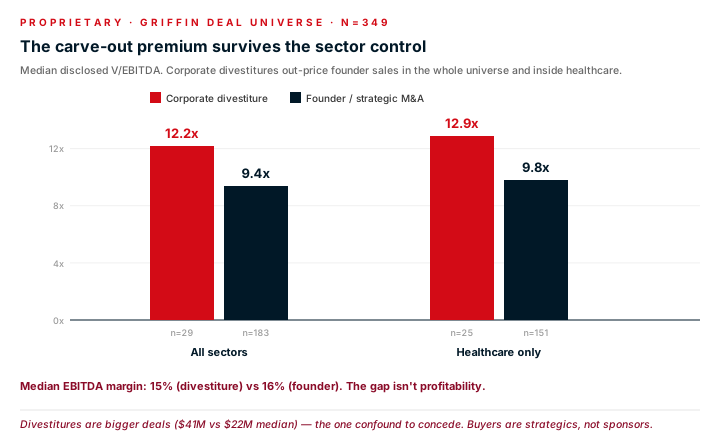
On disclosed deals, corporate divestitures clear a median 12.2x EBITDA against 9.4x for founder and strategic M&A — nearly three turns higher. The gap holds inside healthcare, where divestitures clear 12.9x against 9.8x for founder sales, on 25 and 151 disclosed deals respectively. It is not a profitability story: median EBITDA margins are effectively identical, 15% for divestitures against 16% for founder sales, so the premium is not buying better economics.
There is one confound worth conceding outright. Divestitures are bigger — a median $41.2M of deal value against $21.6M for founder sales, and $37.0M of target revenue against $14.1M — and size and preparation travel together. And the buyers differ in kind: corporate divestitures are bought overwhelmingly by strategics, not sponsors, with almost no repeat acquirer across the set. What the divestiture is not is cheap.
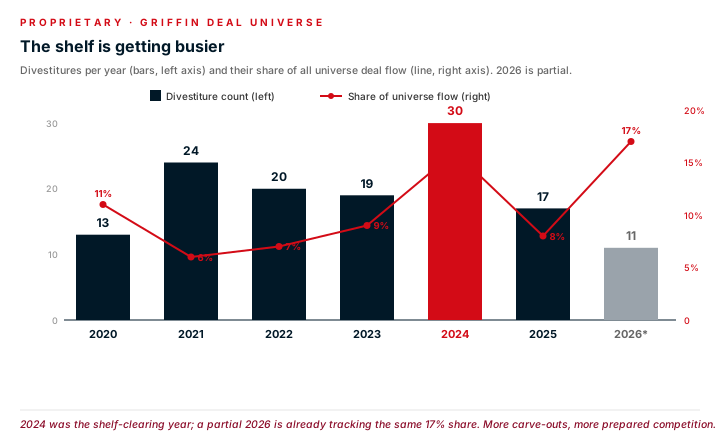
The carve-out is also becoming a larger share of the market. Divestitures ran between 6% and 11% of universe deal flow from 2020 through 2023, then jumped to 16% in 2024 — thirty deals, the peak year — and a partial 2026 is already tracking 17%. Corporations are pruning portfolios into the strong multiple environment that followed the 2023 trough. For a seller, the read-through is competitive: more carve-outs means more prepared, well-run assets chasing the same strategic buyers.
What a corporate seller does by default is what a private seller almost never does: define a clean perimeter, produce audited carve-out financials, run a banked process with a board that will not anchor to a founder's number, and negotiate without the emotional discount that comes from selling something you built. Every one of those is available to a private seller. Almost none adopt them, which is the real subject of the companion argument we have made about what institutional preparation looks like for a family-owned business. The honest caveat is the one that governs the whole universe: only 29 of the 140 divestitures disclose a multiple, and disclosure leans expensive. But the direction is not subtle, and the mechanism — preparation, not provenance — is one a founder can copy.