
In nearly every process that produces more than one bid, the highest number arrives from the buyer the management team likes least. That is not bad luck; it is structure. The buyer who needs the company most — who overlaps least, integrates hardest, and cuts deepest — is the one who can justify the largest synergy number, and therefore the largest headline. Fit and price are negatively correlated by construction, which is why 'take the highest offer' is worse advice than it sounds.
A headline price is not a number; it is a package with a probability attached. It resolves into cash at close, rollover equity, escrow, an earnout, and the odds the deal closes at all. Restate two offers in those terms and the ranking can invert.
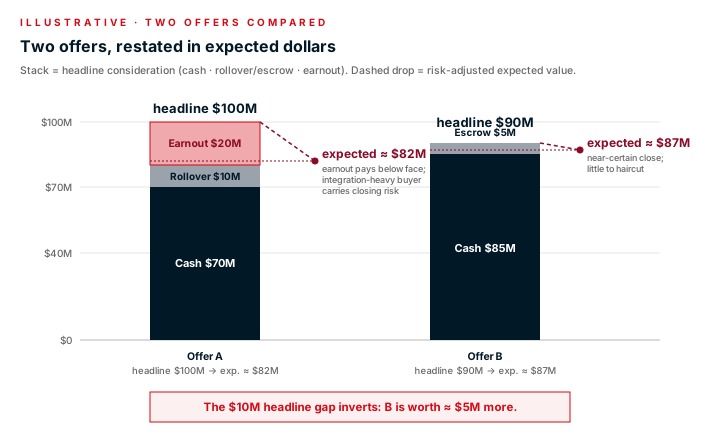
Consider a composite drawn from live processes, with illustrative figures. Offer A carries a $100M headline: $70M of cash, $10M of rollover, and a $20M earnout. Earnouts pay well below face — a gap we have documented — and an integration-heavy buyer carries real closing risk, so the expected value lands in the low $80s, call it $82M. Offer B carries a $90M headline: $85M of cash and a $5M escrow, with a near-certain close, for an expected value near $87M. The $10M headline gap does not merely narrow; it inverts, before anyone has said a word about fit.
The fit factors most sellers treat as sentiment are also cash flows, and they can be priced in the same units as the headline. Employee retention and earnout achievability are lower under the buyer who guts the organization than under the one who keeps it — which reaches back into the earnout column and marks it down. Rollover equity is worth more under the better operator, because the second bite of the apple is a bet on the acquirer's own value creation. Certainty and speed are discount-rate items: a dollar that is nearly certain and arrives sooner is worth more than a larger dollar that is contingent and slow. Even the seller's ongoing role carries a number, if only in the probability that the earnout is ever earned. Convert each of these into an expected-dollar adjustment and the two offers can be compared in one column of the same currency.
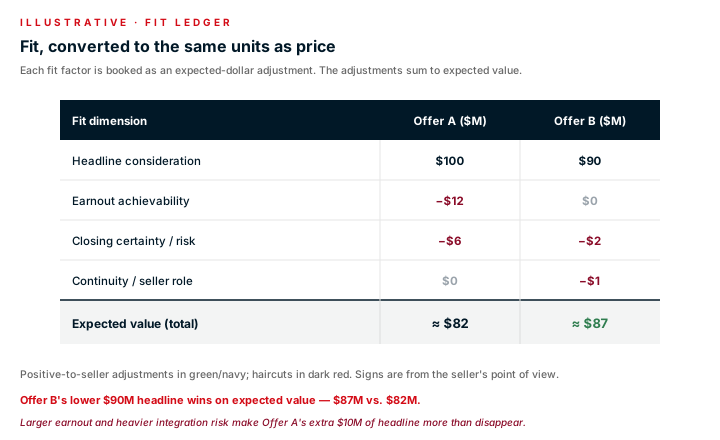
The instruction is narrow, and it is the opposite of the reflex. Never compare headlines. Restate every offer as a risk-adjusted package, price the fit factors in the same units, and only then let fit break the tie. A seller who has done that arithmetic can take the lower headline with a clear conscience, or the higher one with open eyes — but either way they are choosing between two known quantities rather than two marketing numbers. The best price and the best buyer are usually different companies. The work is knowing, in dollars, exactly how different.