
An earnout is what two negotiators do when they cannot agree on what a business is worth. The buyer is willing to pay X. The seller is convinced of X plus Y. The earnout contracts the difference: pay X today, pay up to Y over the next two or three years if the business performs.
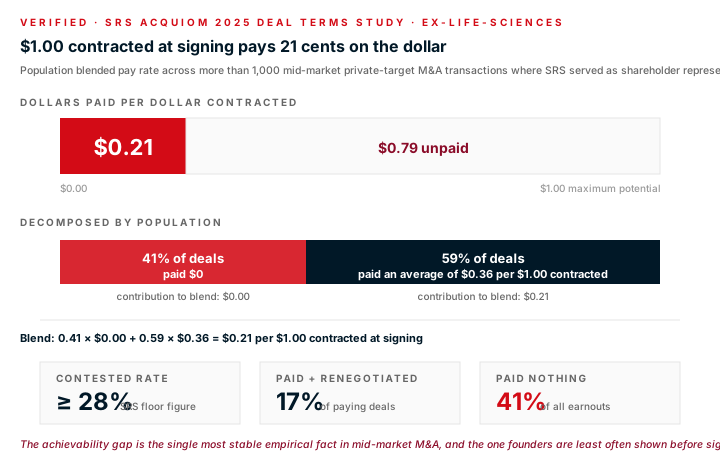
That is the founder's reading of the document. It is not the data's reading. Across the most comprehensive aggregated dataset of mid-market private-target M&A — SRS Acquiom's 2025 Deal Terms Study, drawn from more than a thousand transactions in which SRS served as shareholder representative — earnouts pay 21 cents on the dollar. Not 21 cents on the X-plus-Y. 21 cents on the upside dollars contracted at signing. The bio-pharma cut is 19 cents.
That number is the achievability gap. It is the single most-asked-and-rarely-answered question at every middle-market closing table, and the data has been telling the same story for the better part of a decade. Founders contract for upside they will not receive.
Earnouts are not a buyer's tool or a seller's tool. They are a deadlock-breaking tool. The buyer underwrites a base case — usually a continuation of the trailing twelve, with skepticism toward any forward growth assumption that has not already materialized. The seller underwrites a forward case — pipeline, conversion, retention, a category-tailwind read that the buyer's diligence will not credit. The earnout converts the seller's belief into a contingent claim, and both parties walk to the closing table with a number they can defend internally.
The mechanism is rational. The data on its outcomes is unforgiving. Cain, Denis, and Denis (2011) — the foundational empirical study on earnout structure — showed that earnouts cluster in transactions where the valuation gap is largest: privately held targets, intangible-heavy categories, founder-led businesses where the seller's information advantage is most pronounced. Those are exactly the transactions where post-close performance is hardest to predict and easiest to dispute. The structural feature that makes earnouts useful at signing is the same structural feature that makes them fragile at maturity.
Across the SRS Acquiom 2025 Deal Terms Study sample, 41% of earnouts pay zero. 59% pay something. Of the 59% that pay, the average payment is roughly half the maximum potential. The arithmetic — 0.59 × 0.50 — produces a 30-cent recovery rate among paying earnouts, which when blended with the 41% zero-recoveries produces the headline 21-cent-on-the-dollar overall figure that has been remarkably stable across SRS's recent annual studies. In bio-pharma, the figure is 19 cents.
The dispute rate runs alongside that math. SRS reports that earnouts are contested in at least 28% of cases — a floor figure, since contestation is measured from formally documented dispute and excludes the informal renegotiation that resolves the rest. Of the 59% of deals that paid anything, 17% required renegotiation to avoid litigation. Together those facts describe a market where roughly one earnout in three produces a structural conflict between the parties that has to be resolved by lawyers, not by contract.
Three mechanics. The first is definitional drift. An earnout reads simply at signing — "EBITDA above $40M for fiscal 2026 triggers a $10M payment." It reads less simply when post-close integration changes the cost base, allocates corporate overhead, redefines normalized EBITDA, or absorbs the target into a buyer P&L where what counts as a target-attributable expense is now a matter of judgment. The seller signs against one definition. The buyer measures against another.
The second is the denominator game. Revenue-based earnouts are vulnerable to channel-stuffing in reverse — buyers pulling forward or pushing back recognition to manage the timing of an earnout payment. EBITDA-based earnouts are vulnerable to expense allocation. Milestone-based earnouts in life sciences are vulnerable to prioritization decisions on which programs to advance. In every case, the buyer holds the levers post-close and the seller holds a contract that says "this is what we agreed to," which is not always the same thing as "this is what we get."
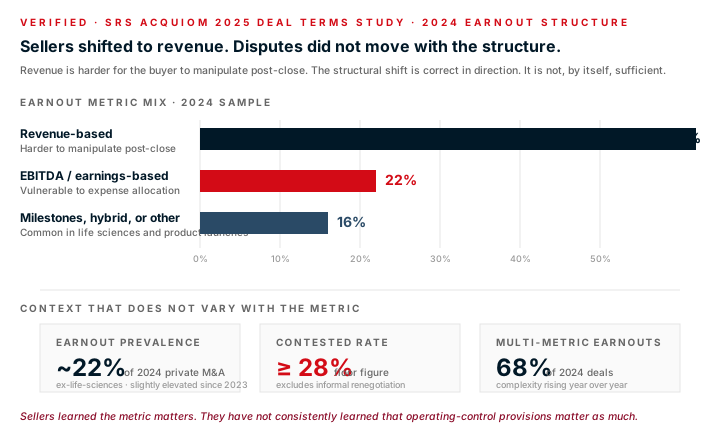
The third is operating control. Once the close happens, the buyer makes the operating decisions. SRS data shows that 62% of 2024 earnouts used revenue as the metric and only 22% used earnings or EBITDA — a meaningful seller-side shift toward the metric that is harder to manipulate. The shift is in the right direction. It is not, by itself, sufficient. Sellers have learned that revenue is the safer metric. They have not consistently learned how to negotiate the operating-control provisions that determine whether even a revenue-based earnout is achievable.
Sellers who watch their earnout drift sometimes assume that Delaware courts will fill the contractual gaps with an implied covenant of good faith and fair dealing. The case law has been clear on this point for more than a decade, and the clarity is unfavorable to sellers.
Lazard Technology Partners v. Qinetiq North America Operations (Del. 2015) is the reference. Cyveillance, the cyber-technology target, agreed to a $40M up-front plus $40M earnout structure tied to revenue thresholds. The earnout did not pay. The seller-representative argued that the buyer had taken post-close decisions — diverting revenue to affiliates, slow-walking sales effort — that suppressed the earnout. The merger agreement contained an express covenant prohibiting the buyer from taking action "with the intent of reducing or limiting the Earn-Out Payment." The Delaware Supreme Court ruled for the buyer. The express provision required intent to suppress the earnout. Conduct that had the effect of suppressing the earnout, but was not undertaken with that intent, was not a breach. The implied covenant did not extend the buyer's obligation beyond the four corners of the contract.
That ruling has been applied repeatedly since. More recent Delaware Chancery decisions have nuanced the standard around "efforts" clauses and best-efforts obligations, and a 2025 Chancery decision extended an earnout period to remedy a buyer's clear breach. But the underlying lesson is unchanged: Delaware courts enforce what the agreement says, not what the seller hoped it would say. An earnout that depends on the implied covenant to deliver value is an earnout that has already failed.
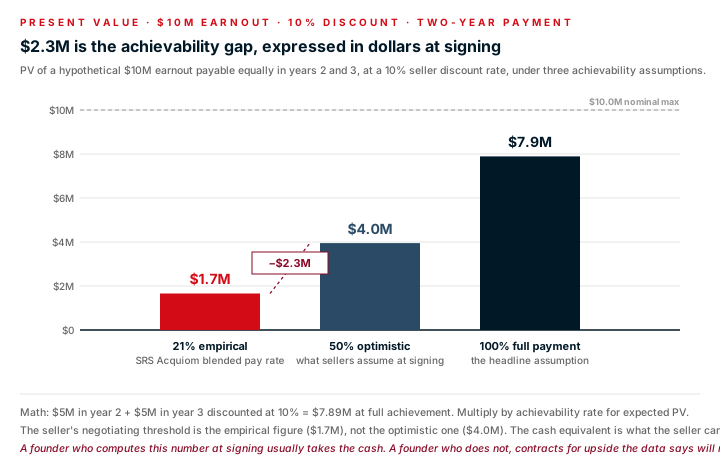
Once the empirical pay rate is in hand, the earnout's value at signing collapses to a present-value calculation any seller can do at the kitchen table. Take a $10M earnout payable in years two and three. At a 21% empirical achievability rate and a 10% discount rate, the expected present value is approximately $1.7M. At a 50% achievability rate — what an optimistic seller might assume — it is approximately $4.0M. At full achievement, $7.9M.
The seller's negotiating question is therefore mechanical. Below what all-cash equivalent should the seller refuse the earnout? At empirical rates, the answer is approximately $1.7M of additional all-cash. At the seller's optimistic rates, $4.0M. The gap between those two numbers — $2.3M, on a $10M nominal earnout — is the achievability gap, expressed in dollars at the closing table. Sellers who do this math at signing usually take the cash. Sellers who do not, contract for upside the data says they will not receive.
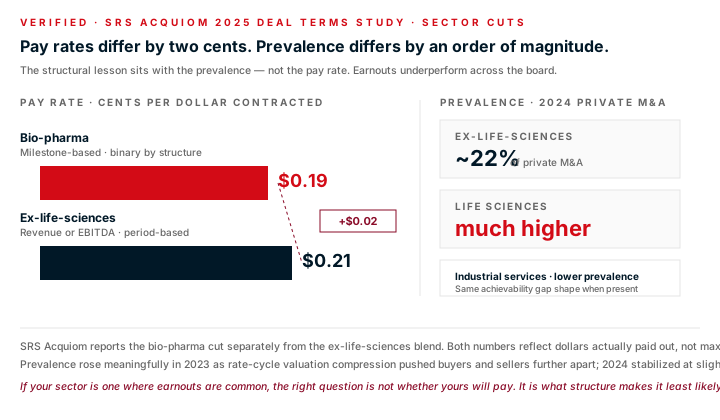
The SRS data permits one clean sector cut: bio-pharma at 19 cents, all other sectors at 21 cents. The bio-pharma figure is not surprising on a milestone-by-milestone basis — life-sciences earnouts are typically structured as binary milestones tied to clinical or regulatory events, and the base rate of any given biotech program reaching any given milestone is itself low. The two-cent difference between bio-pharma and the rest of the market is small enough that the temptation to read sector-specific advice into it is mostly unjustified. Earnouts underperform across the board.
What does vary by sector is prevalence. SRS reports approximately 22% earnout prevalence in private M&A excluding life sciences in 2024 — a figure that rose meaningfully in 2023 as the rate cycle compressed valuations and pushed buyers and sellers further apart. In life sciences, prevalence runs much higher because the contingent-payment structure maps naturally onto the development-stage milestone economics of the category. In industrial services, prevalence is lower than in technology or healthcare, but the achievability gap, when present, follows the same shape.
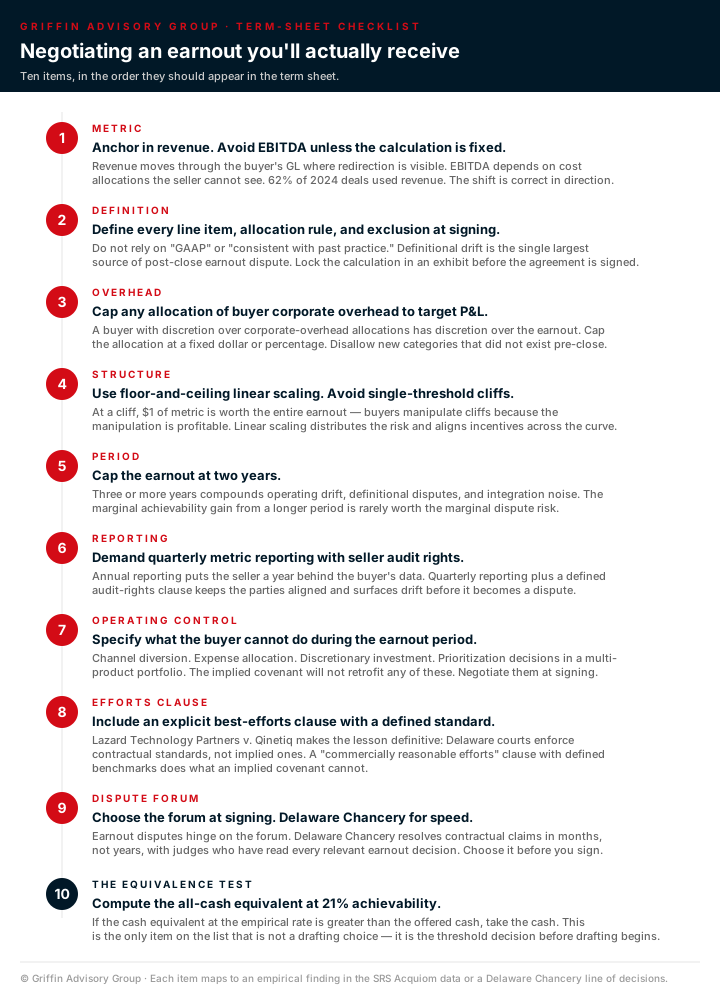
If sellers cannot reliably negotiate an achievability rate above the empirical median, they can at least negotiate the structural features that determine which side of that median they fall on. Three matter most.
The first is the metric. Revenue-based earnouts are harder to manipulate than EBITDA-based earnouts because the line item moves through the buyer's general ledger as part of the consolidated revenue line, where any redirection is visible to the seller's auditors. EBITDA-based earnouts depend on cost allocations the seller cannot see and the buyer's auditors will not contest. The 2024 SRS data showing the seller-side shift toward revenue is correct in direction. It is not, by itself, sufficient.
The second is the operating-control regime. The earnout agreement should specify, at term-sheet level, what the buyer can and cannot do during the earnout period. Channel diversion. Expense allocation. Discretionary investment. Prioritization decisions in multi-product portfolios. Those provisions are negotiated at signing or they are not negotiated at all — the implied covenant will not retrofit them.
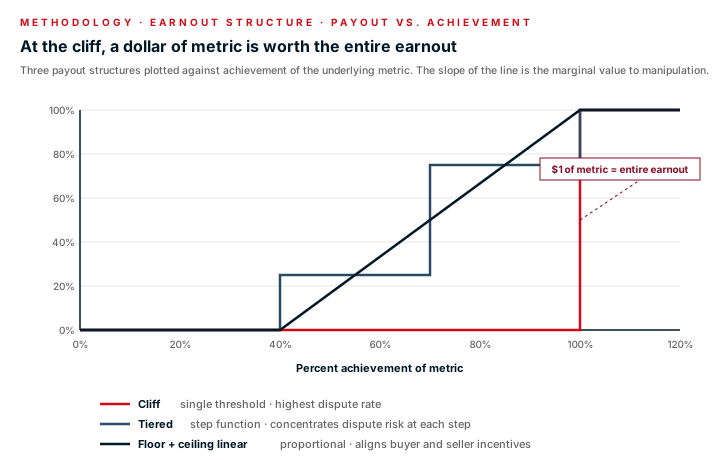
The third is the cliff. Earnouts with single-threshold cliffs — full payment at $X EBITDA, zero below — produce the highest dispute rates and the largest gap between achievability and payout. Earnouts with linear scaling between a floor and a ceiling produce more aligned outcomes. The reason is mechanical: at the cliff, the marginal value of a dollar of EBITDA is the entire earnout. At a floor-and-ceiling structure, marginal value scales with performance. Buyers manipulate cliffs because the manipulation is profitable. They manipulate scaled structures less because the manipulation is less profitable.
The prescriptive section of this analysis follows directly from the data. The founder reading this piece across a closing table is solving a real-time decision problem, and the data is best honored by a checklist — a term-sheet artifact that travels with the negotiation, not a literary one that gets put down before the term sheet gets signed.
The aggregate figures in this analysis are drawn from SRS Acquiom's 2024 and 2025 Deal Terms and M&A Claims Insights studies, which represent the most comprehensive aggregated dataset of mid-market private-target M&A available in the United States. The Lazard Technology Partners v. Qinetiq North America Operations ruling and the recent Delaware Chancery line of decisions on best-efforts obligations are public record. The case-law illustration is intended to show what courts will and will not enforce; it is not legal advice.
Two figures in this piece — the 21-cent and 19-cent pay rates — anchor everything that follows. They are SRS Acquiom's published numbers, drawn from a transactional dataset substantially larger than any individual advisor's mandate book. We have read them, in different forms, in eight consecutive years of SRS publications. They have not moved meaningfully. The empirical achievability of mid-market earnouts is one of the more stable facts in the M&A data.
What changes year to year is prevalence — 2023 saw a meaningful jump as rate-cycle valuation compression pushed buyers and sellers further apart; 2024 stabilized at slightly elevated levels — and the structural mix, where revenue-based earnouts have steadily displaced EBITDA-based ones. What does not change is the gap. Founders are well served to know it before they sign.