Roll-up strategies run on a simple arithmetic: acquire small at four to five times EBITDA, consolidate onto the platform's eight to ten times multiple, and repeat. The logic is real, and it has built some of the best-performing sponsor portfolios of the last decade.
But the headline arithmetic is not the whole arithmetic. We work with enough acquirers in the specialty industrial-services category to say plainly: the 4×-in, 8×-out story is not wrong — it is incomplete. The places it quietly leaks are the places that separate good platforms from great ones.
Consider an illustrative platform — call it Vanguard Integrity Services, a specialty industrial inspection operator with $38M of run-rate EBITDA, clearing at 9.25x. On the shelf are four add-on targets, each with roughly $4M of EBITDA, acquirable at 5.0x through proprietary senior-banker outreach.
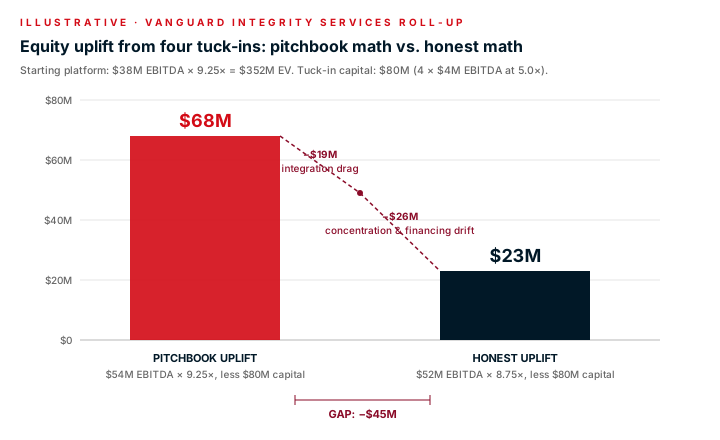
The idealized math runs as follows. The platform is worth $352M at entry. Each add-on costs $20M, for $80M of total tuck-in capital. Post-close, the combined EBITDA base is $54M. Hold the platform multiple constant, and the combined enterprise value is $500M. The roll-up has created $68M of equity value on $80M of outlay — a 0.85x cash-on-cash uplift before any operating improvement, organic growth, or time value.
That is the story the pitchbook tells, and for a clean, execution-disciplined platform in a fragmented category, it is approximately true. The word doing work in that sentence is 'approximately.' Three specific places the math leaks are worth naming.
The acquired EBITDA is not acquired EBITDA. Integration runs through the P&L, not around it. For a technician-led specialty services platform, integration costs include system migration (CRM, scheduling, safety compliance), retention bonuses for key field leaders, certification and cross-training for the acquired technician base, and the back-office absorption that was supposed to be free synergy.
In practice, a $4M EBITDA tuck-in in this category typically runs through a $0.5M–$1.0M integration drag in year one and settles into a steady-state contribution of $3.0M–$3.4M by year two. Apply that across four tuck-ins and the combined platform does not clear $54M of run-rate EBITDA — it clears closer to $52M once integration is fully burned. The multiple at exit is applied to the lower number, and the pitchbook's first assumption has quietly given back a turn of dollars.
A roll-up is supposed to diversify the customer book. It often does the opposite. If the Vanguard platform book is forty percent weighted to power and utility customers, and three of the four add-on targets are also power-and-utility weighted — because those are the operators a senior banker can source at disciplined multiples — then the combined book is more concentrated than the original, not less.
Acquirers at exit notice. A combined entity with sixty percent exposure to a single regulated-customer category does not clear at the same multiple as one with a more even split across power, manufacturing, and infrastructure. The exit comp set tightens, and the multiple drifts. A half-turn of compression on $52M of EBITDA is roughly $26M of enterprise value — most of it taken straight out of the arbitrage gain the pitchbook promised.
The third leak shows up at exit financing. At $38M of platform EBITDA, a disciplined sponsor can raise six to seven turns of total leverage with reasonable flexibility. At $80M of combined EBITDA, the deal crosses into a different buyer universe and a different lender posture. Upper-middle-market and large-cap sponsors underwrite more conservatively on multi-regional operations. Lenders apply tighter haircuts to EBITDA adjustments, run more detailed sensitivities on technician-headcount continuity, and penalize regulatory-customer concentration more heavily.
The practical consequence is that the next buyer may be underwriting the platform at six turns of leverage instead of seven, at a spread forty to sixty basis points wider than the original sponsor enjoyed. That compresses the exit IRR math and, by extension, the price the exit buyer is willing to pay. The platform-multiple expansion that was supposed to be automatic at scale is not automatic at scale.
What does the honest version of the arithmetic look like? Start with the same $38M platform at 9.25x and the same $80M of tuck-in capital. Then mark down the combined EBITDA for integration friction — from $54M to roughly $52M. Mark down the exit multiple for concentration drift and exit-financing discipline — from 9.25x to something closer to 8.75x. Run those marks through and the combined enterprise value is nearer $455M than $500M, and the tuck-in capital produces a cash-on-cash uplift closer to a third of what the pitchbook showed.
Still positive. Still worth doing. But a very different return profile than the headline story, and a materially different conversation with a seller the platform is trying to convince to roll equity.
The distinction matters because the platforms that compound over multiple holds are not the ones that ignore the leaks. They are the ones that price them in, diligence them hard, and allocate management attention to closing them. The arithmetic is not the story. The execution discipline around the arithmetic is.