
The case studies we publish usually composite our own work. This one does not. The PGT Innovations transaction — announced by Masonite International in December 2023, topped by MITER Brands in January 2024, and closed at $42.00 per share all-cash on March 28, 2024 — is on the public record in full. Proxy, 10-K, press releases, S-4, termination agreement. Every number in what follows can be traced to a filing or a market print.
We wanted to write against a public deal for two reasons. The first is that the PGT process contains three structural features we teach against in our own mandates: consideration-structure erosion when a stock component moves against the seller, the headline-versus-economic price distinction in a mixed-consideration bid, and the arithmetic of a superior-proposal topping mechanic including the termination-fee cost. The second is that when the work is public, the reader can check it — and a sell-side banker's best discipline is analysis that survives the scrutiny of someone with access to the same filings and the incentive to disagree.
PGT Innovations was, at the time of the transaction, a publicly traded Florida building-products company headquartered in Venice, focused on impact-resistant windows and doors. It operated through a set of brands — PGT Custom Windows + Doors, CGI, WinDoor, Western Window Systems, Eze-Breeze, NewSouth Window Solutions, and Anlin Windows and Doors acquired in early 2022 — across the premium, mid-market, and direct-to-homeowner segments of the residential fenestration category. The business had four defining features: a specialty focus on hurricane-code and energy-code-driven impact glass; a geographic concentration in Florida and the Sunbelt; a multi-brand channel architecture serving builders, dealers, and homeowners; and an acquisitive growth record that had compounded revenue from roughly $700M in 2018 to $1.5B by 2023.
For a strategic acquirer in the broader door-and-window category, PGT was a scarce asset. Impact-resistant glass is a code-driven, non-discretionary product in the markets that require it. The Florida concentration, which in other building-products categories is treated as a risk factor, is treated in impact as a moat — it is the single deepest pool of impact-mandated demand in the U.S. and is the training ground for the manufacturing, engineering, and certification capabilities the category runs on. The 2022–2023 tuck-ins had built out West Coast exposure, mid-market breadth, and direct-to-homeowner channel capacity that a strategic without that footprint would have had to spend years and significant capital to replicate.
The residential fenestration category in the United States is approximately a $24B market at the retail level, with a long tail of regional manufacturers, three national strategic scale players, and a premium layer concentrated around specialty codes and architectural segments. Impact-resistant windows and doors — PGT's core — represent a subset that grows faster than the base category because it is tied to building-code cycles, insurance-driven re-glazing, and post-storm hardening rather than general housing starts. Within impact, Florida is the single largest addressable submarket and carries the category's highest gross margins because of product specification and certification cost.
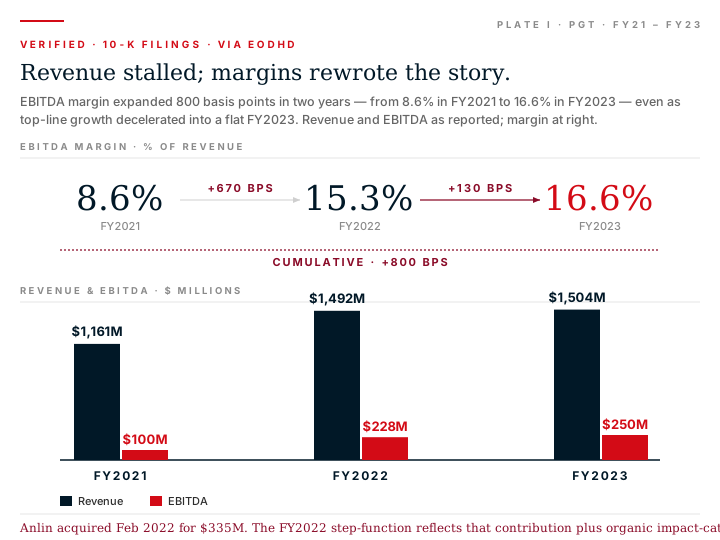
PGT's three-year trajectory reflected that tailwind compounding with acquisition. Revenue grew from $1,161M in 2021 to $1,492M in 2022 to $1,504M in 2023. The 2022 step-function — roughly $330M of incremental revenue — reflected two drivers: the February 2022 acquisition of Anlin for $335M, which added West Coast exposure at approximately $200M of run-rate revenue; and underlying impact-category strength in Florida as insurance premiums rose and re-glazing accelerated. The 2023 print — essentially flat on top line year-over-year — reflected a mid-cycle residential new-construction softening that was offset by impact-category resilience and pricing pass-through.
The EBITDA story was the more interesting one. EBITDA grew from $100M in 2021 to $228M in 2022 to $250M in 2023, with margins expanding from 8.6% to 15.3% to 16.6% over the period. That is roughly 800 basis points of margin expansion over two years in a category where 300–500 basis points is a strong print. The drivers were a combination of pricing, category mix shift toward higher-margin impact and premium segments, Anlin's accretive margin structure, and operating leverage on a base that had absorbed three years of integration cost. A buyer reading this profile in late 2023 would have seen that FY2023 EBITDA at $250M was a clean trailing number, not a stretched adjusted figure — reported EBITDA, filed in the 10-K on February 23, 2024, with no dispute.
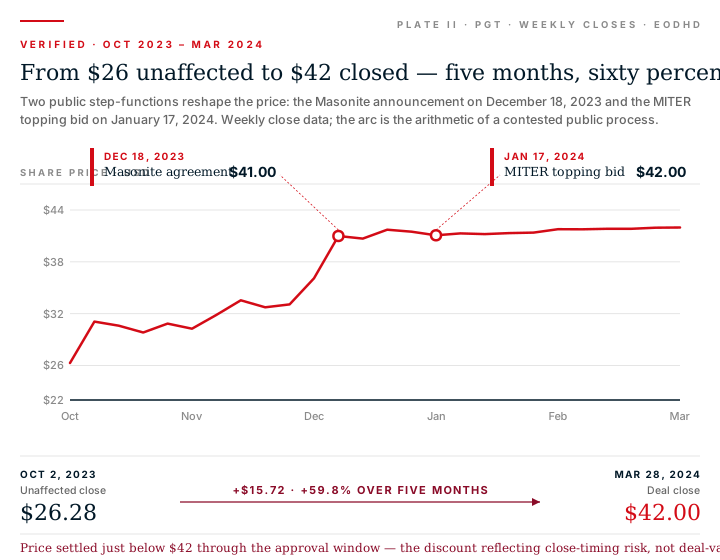
PGT's share price on the Friday preceding the Monday, October 9, 2023 rumor cycle closed at $26.28 on unaffected volume. That is the reference point against which the subsequent offers should be read. At $26.28, the trailing EBITDA multiple was approximately 7.2x and the forward P/E was in the low teens — a public-market valuation that was reasonable for a building-products operator with PGT's growth and margin profile, but that did not reflect the category scarcity that a strategic would price into. News and speculation about inbound interest moved the stock into the low $30s by mid-October, where it held for several weeks.
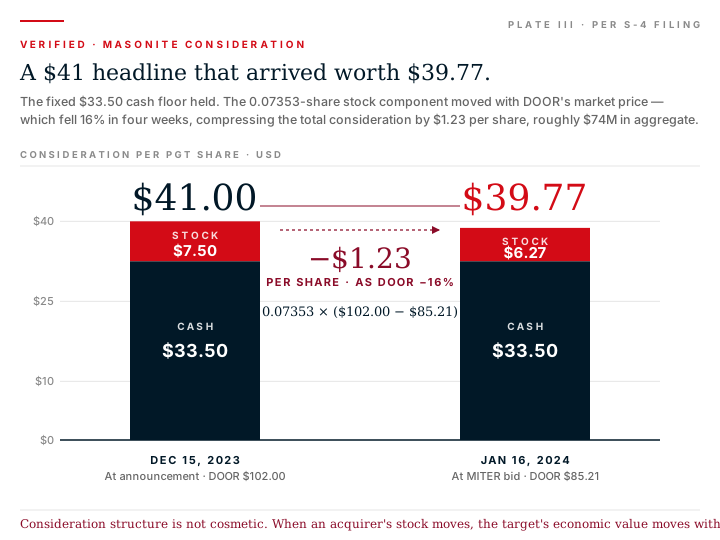
On December 18, 2023, Masonite International (NYSE: DOOR) announced an agreement to acquire PGT for $41.00 per share, structured as $33.50 in cash plus 0.07353 shares of Masonite stock. At Masonite's pre-announcement share price of approximately $102, the stock component was worth $7.50, and the headline reconciled to $41.00 — a 56% premium to the unaffected close. Masonite's stated strategic rationale was the creation of a unified residential building-products platform combining its doors franchise with PGT's impact-resistant windows exposure. PGT shares traded at or just below $41 for the four weeks following the announcement, the gap reflecting close-timing and exchange-ratio risk rather than deal-value risk.
The structure choice — a cash-plus-stock blend rather than all-cash — is where the first piece of the case study's analytical work lives. A cash-plus-stock deal delivers the target shareholder a claim on both a fixed cash payment and the forward equity value of the acquirer. When the market reads the deal and moves the acquirer's stock, the economic consideration to the target shareholder moves with it.
Masonite's stock fell from approximately $102 pre-announcement to approximately $85.71 on the announcement day itself — a 16% single-day decline reflecting investor concern about leverage, integration risk, and segment-mix impact. By January 16, 2024, DOOR closed at $85.21, and the 0.07353 stock component was worth $6.27. The total consideration per PGT share had compressed from $41.00 to $39.77. Across approximately 60M fully diluted shares, that $1.23-per-share erosion translated to roughly $74M of value decay in four weeks.
Two things follow. First, the PGT shareholder who had agreed to the deal at the $41.00 headline was, by mid-January, holding an instrument worth $39.77. Second, the acquirer's stock decline is itself information. A stock moving materially against announcement is the market signaling that it does not agree with the deal's strategic or financial logic. A disciplined buyer would have priced that signal into both the headline structure and the fixed-versus-floating mix. Masonite did not, and the consequence was that a superior-proposal window opened earlier than the original bid structure assumed.
On January 17, 2024, MITER Brands — backed by Koch Equity Development — submitted an unsolicited superior proposal to acquire PGT at $42.00 per share, all cash. PGT's board, after required consultation with its financial advisor, determined the MITER proposal constituted a superior proposal under the Masonite agreement and, following the contractually mandated four-business-day negotiation window, terminated the Masonite deal and paid the $84M termination fee to Masonite. The revised agreement with MITER was executed, and the transaction closed on March 28, 2024.
The analytical question the PGT board had to answer — and the question a middle-market seller in a contested auction almost always faces — was not whether $42 was higher than $41. It was whether $42 in cash was materially better than a $41 blended consideration that had already compressed to $39.77 in market value, and whether the economic uplift from the MITER bid justified the termination-fee cost and the timing shift.
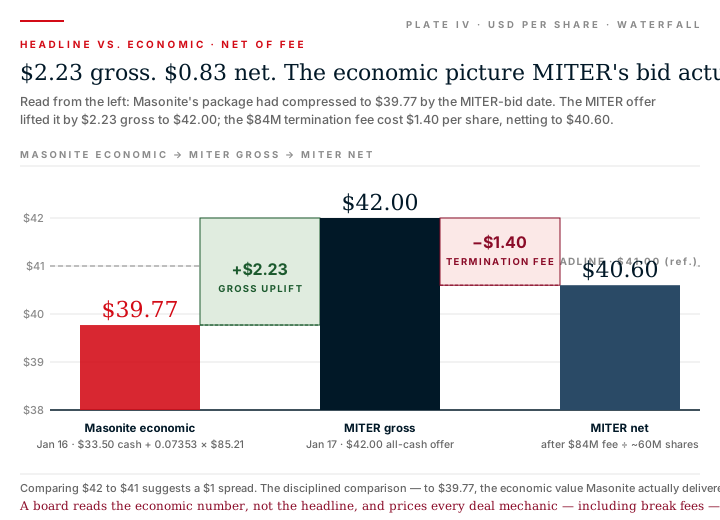
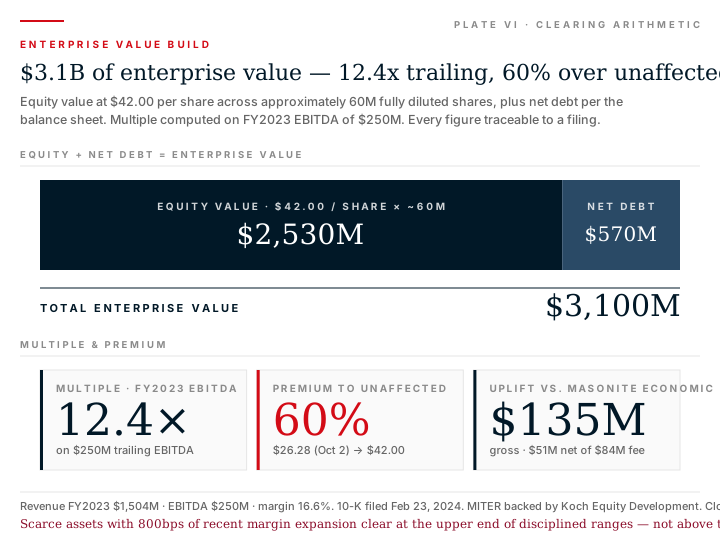
The arithmetic cuts cleanly. At the moment of the MITER bid, the Masonite consideration was worth approximately $39.77 per share. MITER's $42.00 all-cash offer represented a $2.23-per-share economic uplift over the Masonite package as it actually stood — not the $1.00 headline spread that comparing $42 to $41 would suggest. Across roughly 60M fully diluted shares, the economic uplift was approximately $135M of shareholder value. The $84M termination fee, paid by PGT from cash that would otherwise have transferred to shareholders in the close, reduced that uplift to roughly $51M of net benefit — still meaningfully positive, and crucially paid in certain cash rather than a floating-price stock instrument. The elimination of exchange-ratio risk, integration uncertainty, and two-to-three-month market exposure to DOOR's share price was itself a substantial component of the economic improvement.
The exercise we want to walk through is the one we would have run had we been advising PGT on a voluntary sell-side process: what valuation range would a reconciled, methodology-disciplined pre-marketing analysis have produced? Not a pricing inference drawn from the clearing number — a forward view built from the same data any disciplined bidder was using in late 2023.
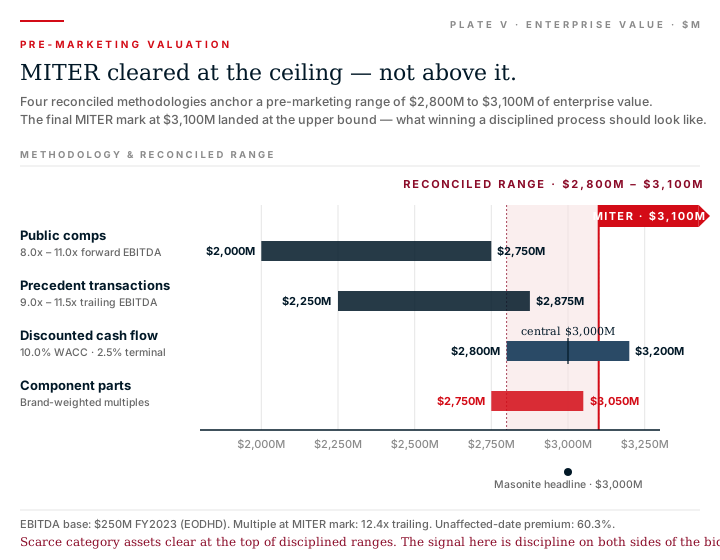
Public comps in the residential-building-products category were trading in a range of approximately 8.0x to 11.0x forward EBITDA at the time, with specialty and impact-leveraged names at the upper end. Applied to a conservative $275M forward EBITDA estimate reflecting FY2023 margin consolidation plus modest category growth, that produces an enterprise-value range of $2,200M to $3,025M. Precedent strategic transactions in the category cleared in the 9.0x to 11.5x trailing EBITDA range when the target was a scale platform with defensible category position. PGT, with its impact-category concentration and scarcity characteristics, would have anchored toward the upper half of that range.
A DCF constructed at a 10.0% WACC on five-year projections that held margins at the 16–17% range and grew revenue at mid-single digits produces a central value in the range of $2,800M to $3,200M of enterprise value. A component-parts analysis — impact-weighted brands at a premium, Sunbelt mid-market brands at the category median, direct-to-homeowner Anlin at an accretive multiple — would have produced a similar central range with tighter dispersion. Reconciled, a disciplined pre-marketing valuation range for PGT in late 2023 would have centered on $2,800M to $3,100M of enterprise value — roughly 11.0x to 12.5x trailing EBITDA.
The MITER clearing price of $42.00 per share produced approximately $2,530M of equity value, which combined with approximately $570M of net debt at close produced approximately $3,100M of enterprise value. That is at the upper end of the reconciled range — what winning a competitive process for a scarce asset should look like, not above it.
The final transaction cleared at $42.00 per share in all cash. Equity value across approximately 60M fully diluted shares was approximately $2,530M. Net debt of approximately $570M at close produced approximately $3,100M of enterprise value. The multiple on PGT's FY2023 trailing EBITDA of $250M was 12.4x. The premium to the unaffected price of $26.28 was approximately 60%.
What that pricing tells the careful reader is that PGT cleared the market, not above it. The process — even in its contested, public form — produced a clearing number consistent with what a rigorously reconciled pre-marketing valuation would have anchored on, with the scarcity and strategic-fit premium captured by the topping bid rather than by negotiation from a single preferred bidder.
Three takeaways generalize. The first is that consideration structure is not a cosmetic detail of a deal — it is a substantial piece of the economics. A target shareholder agreeing to a mixed-consideration package is taking an exchange-ratio position on the acquirer's forward stock price, often through months of closing exposure. When the acquirer's stock moves against the deal, the target shareholder's consideration erodes dollar-for-dollar at the weight of the stock component. A bidder offering all-cash at a modestly lower headline is often offering more economic value than a higher-headline blended package, and a target board that prices consideration in risk-adjusted economic terms rather than nominal headline terms is doing its job properly.
The second is that the superior-proposal mechanic, priced correctly, can be net-positive even after the termination fee. The PGT board faced a $2.23-per-share economic uplift and an $84M termination fee, which worked out to roughly $51M of net shareholder benefit — not a blockbuster uplift on a $2.5B equity value, but a real one, and one paid in certainty rather than stock-market exposure. The decision to engage with MITER's unsolicited offer, work through the four-day negotiation window, and terminate the Masonite agreement was consistent with fiduciary duty and produced measurable economic benefit.
The third is that scarce assets clear at the top of disciplined valuation ranges, not above them. The intuition that a strategic-versus-strategic contested process produces a ceiling-breaking clear is sometimes right and sometimes wrong. In PGT's case, the MITER $42.00 was at the upper bound of a reasonable pre-marketing reconciliation, not above it. That suggests the market for category-scarce industrial assets in late 2023 was disciplined — bidders stretched toward the top of defensible ranges but did not compress their own returns to buy above them. Sellers reading their own process outcomes should use that as a calibration point: a clearing number at the ceiling of a reconciled range is what winning a competitive process is supposed to produce.
A closing note on method. The PGT transaction is on the public record; every number in this piece traces to a filing or a market print. We wrote it that way on purpose. A case study that cannot be checked against source material is a case study the reader has to take on faith. One that can be checked is a case study the reader can test, and by testing, learn from. Our view is that the second kind is more useful.