
A four percent ten-year should have rewritten the middle-market pricing textbook. In theory, a 150-basis-point rise in the risk-free rate lifts the cost of equity by roughly the same margin, pushes WACC up two to three points depending on leverage, and compresses DCF-implied values by fifteen to twenty percent. Translated into an EBITDA multiple, that is roughly a full turn.
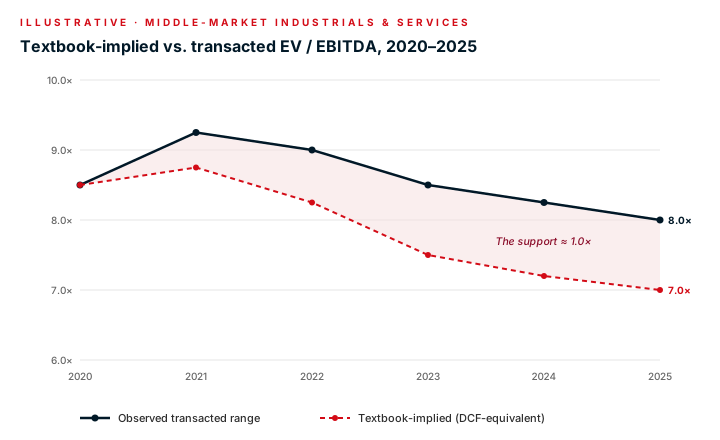
That is the textbook. The transacted market, mostly, did not follow. Multiples in middle-market industrials and services held within a narrower band than the math alone would have predicted. Understanding why matters — because the support that held them up is not uniformly durable.
Start with the discount rate. A typical platform priced on a ten-year DCF at a 9.5% WACC in 2020 clears at a different number at an 11.5% WACC in 2025. Holding the cash flows flat, the value compresses by roughly eighteen percent. On an EBITDA multiple, that is the difference between 8.5x and 7.0x for the same business.
The same logic runs on the leverage side. A sponsor underwriting a five-year hold with seven turns of total leverage at SOFR plus 475 in 2020 is financing at roughly 5.0%. The same package in 2025 is closer to 9.0%. On a deal where debt service consumes a third of EBITDA, that is a real compression of sponsor IRR unless the entry multiple absorbs it.
By the textbook, entry multiples should have fallen meaningfully. In some buckets they did — over-levered sponsor re-trades, large-cap industrial conglomerates, out-of-favor tech. In middle-market industrials and services, the compression was smaller than the discount-rate shift alone would have produced. Typical platforms that cleared in the high-8x range in 2021 have mostly re-cleared in the 7.5–8.5x range in 2025. That is not nothing. It is also not the full turn the textbook predicted.
Consider specialty industrial inspection — the non-destructive testing, asset-integrity, and mechanical-inspection service category serving power, energy, heavy manufacturing, and infrastructure customers. It is a fragmented, high-touch, technician-constrained category with the kind of recurring revenue profile sponsors like and the kind of customer capex exposure that should make it rate-sensitive.
Call the illustrative platform Vanguard Integrity Services — a multi-regional operator with roughly $220M of revenue, $38M of run-rate EBITDA, four acquired tuck-ins in the last three years, and a blended customer book weighted toward regulated utilities and industrial manufacturers. In 2021, a platform like Vanguard cleared at 10.5x trailing EBITDA in a sponsor-led auction. In 2025, the same profile is clearing at 9.25x. The textbook said the number should be closer to 8.25x. What accounts for the difference?
Three structural supports absorbed most of the discount-rate shift. The first is scarcity of quality platforms. The pool of technician-led service businesses with $30M–$60M of EBITDA, clean financials, and durable customer relationships did not grow through the tightening cycle. Sponsors with fresh 2023–2024 vintages hunting for platform deals kept bidding against a thinner supply of qualified targets, and scarcity premium does not soften because rates rose.
The second is structural change in how deals got priced. Earnouts widened, rollover equity percentages rose, seller notes became more common, and closing purchase-price adjustments got tighter. The headline multiple stayed high; the risk-adjusted multiple — what the seller actually bore economically — moved more than the headline number suggested. When an IOI clears at 9.25x with 25% rollover and a three-year earnout, the economic multiple to the cash-out seller is not 9.25x.
The third support, and the most important, is private credit. The emergence of direct-lending funds with $15B–$40B of dry powder, underwriting unitranche paper at six to seven turns and eight to nine hundred basis points over SOFR, kept sponsor leverage capacity open even as bank syndications tightened. That capacity absorbed much of the WACC pressure that would have otherwise forced entry-multiple compression.
The scarcity support is structural and slow-moving — it does not thin unless supply materially expands, which would require a wave of baby-boomer succession transactions or platform carve-outs that has not yet arrived. The structural-pricing support is cyclical; it flexes with buyer discipline and will tighten as diligence gets sharper, but it is not going away.
The private-credit support is the one to watch. Direct-lending funds that raised in 2021–2023 are approaching deployment deadlines and return-of-capital pressures from their own LPs. The best-underwritten paper is performing; the thinner-underwritten paper is not. If defaults in the sponsor-backed middle-market book tick up meaningfully in 2026, underwriting standards tighten, unitranche spreads widen, and the leverage capacity that absorbed the rate shift starts to contract. When that happens, the headline multiple has to absorb what the capital stack no longer can.
The case for transacting in 2026 rests on the fact that all three supports — scarcity, structure, and private credit — are still operative. The case for waiting rests on the expectation that the ten-year drifts lower, the curve normalizes, and the textbook reasserts itself in the seller's favor.
Our read is that the seller who is ready should transact into the support that exists today rather than bet on the support that might arrive tomorrow. The multiple environment is not a tailwind — it is a stable plateau held up by three struts, one of which is showing stress. The prudent move for a seller whose fundamentals are strong is to price into the plateau while it is still standing.